Passive House
Why Passive House?
With the considerable technological advances witnessed and the drive to achieve Passive House sustainability levels, Spitfire front door design has been hugely improved over the last 5 years and we thought it time to update our advice on thermal values.
The UK government’s Energy Saving Trust claims that external doors often account for up to 20% of the heat lost from a home. So, with energy costs only going one way, there is even more reason to fit a Spitfire Door, which in the long run will save you money. And you can be kinder to the planet for future generations to enjoy by selecting a door that could meet Passive House targets.
What we have discovered is that Architects often design Passive House Homes, but the cost of testing the whole house to prove conformance can be cost prohibitive and most people compromise by fitting the best thermally efficient products available, but fall short of overall Passive House certification, because they don’t pay for the whole house testing. To us, that seems a reasonable compromise.
We know that front doors that have extremely low U values easily outperform inferior composite doors which have poor U values, at 1.4 W/m2K or worse. The U value of a door is very important if you want to keep your home warm in winter and reduce your carbon footprint. Spitfire Front Doors easily achieve ratings lower than the Passive House trigger level of 0.8 W/m2K. Even our entry level Spitfire S-100 aluminium doors beat this standard.
Get in touch to find out more.
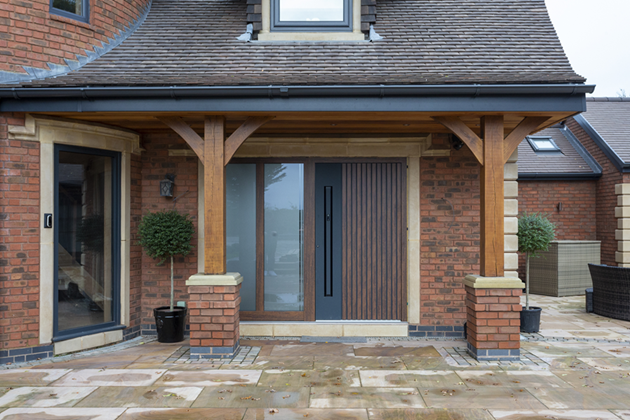
How U Values work
U values measure the rate at which heat is transferred through a material, within a given period of time. The lower the U value, the better the material is at preventing heat loss, known as the thermal conductivity performance. Design your Passiv Haus front door here
The U value of a front door can be affected by several factors, particularly the materials used, the door thickness and the glazing.
The levels achieved by materials :
Standard timber doors: 1.8–2.0 W/m²K.
- Spitfire timber doors: 0.8 W/m²K.
- Modern composite or GRP/Plastic doors: 1.2–1.4 W/m²K.
- Standard steel doors: 1.8–2.0 W/m²K.
- Spitfire Alu-Steel doors: 0.77 W/m²K
- Spitfire Passive House level doors: ≤0.8 W/m²K
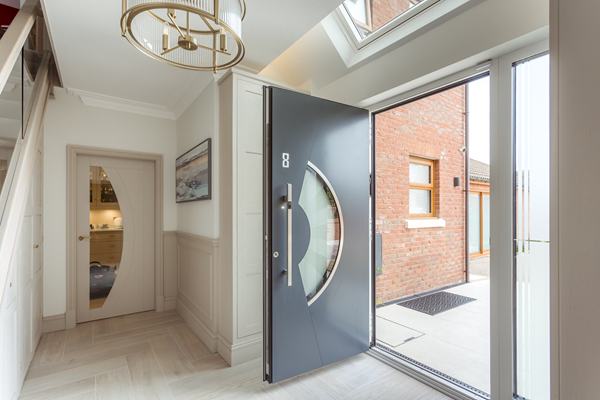
Door Thickness
The depth or thickness of a door is very important in helping to achieve excellent thermal insulation. Deeper door panels usually have lower U Values as they are better insulated, having more space to hold high-density foam. Spitfire Doors vary from 65mm to 115mm thick depending on the door series and thermal requirements stipulated. A typical timber or composite door is only 48mm thick.
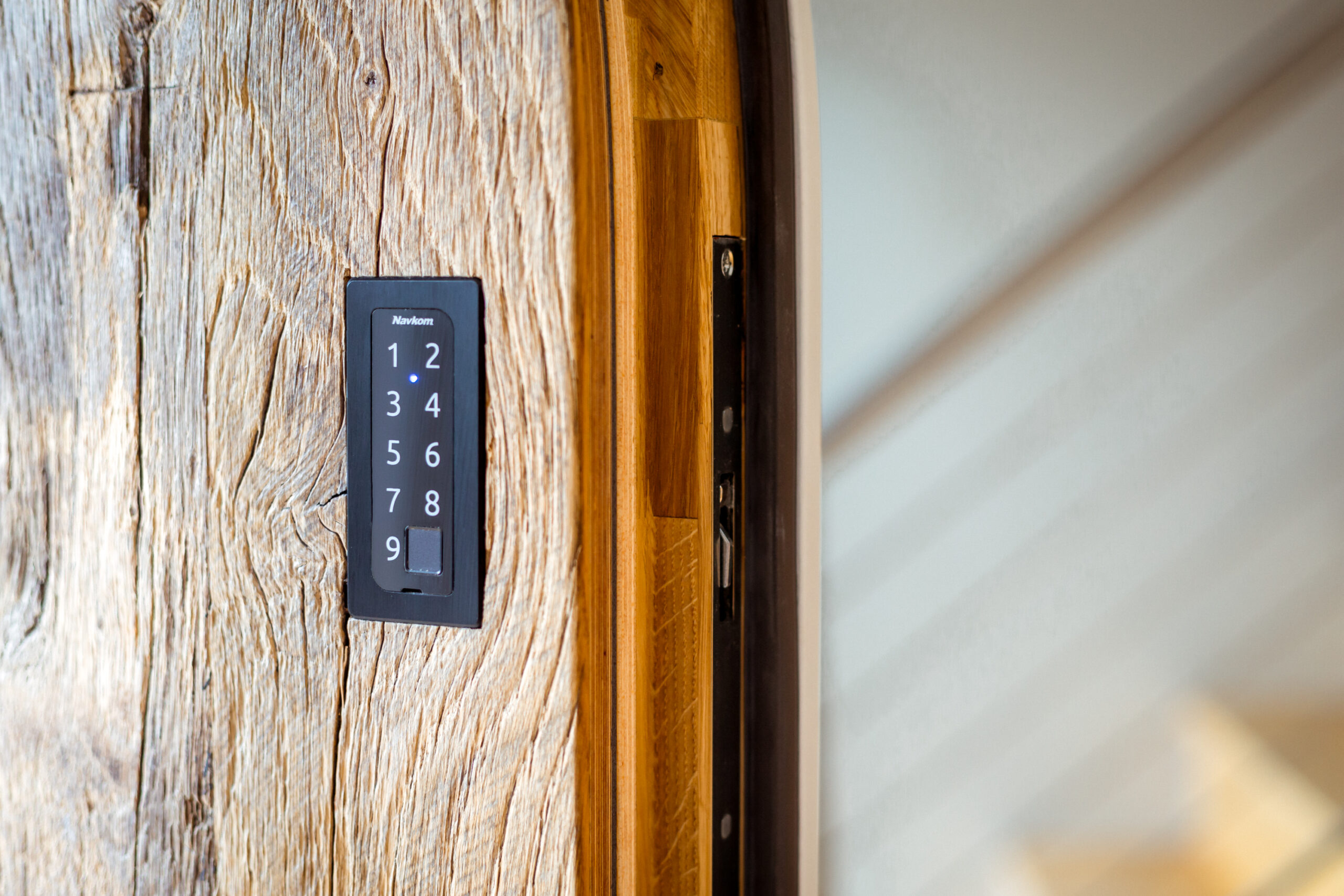
Glazing
Triple glazing is preferable in a front door because that also helps reduce thermal transference. Spitfire Doors are all triple glazed with laminated safety glass and the sealed units are filled with Argon, which further enhances the performance. Standard timber and Composite doors are not thick enough to accommodate triple glazing, which drastically reduces their thermal performance.
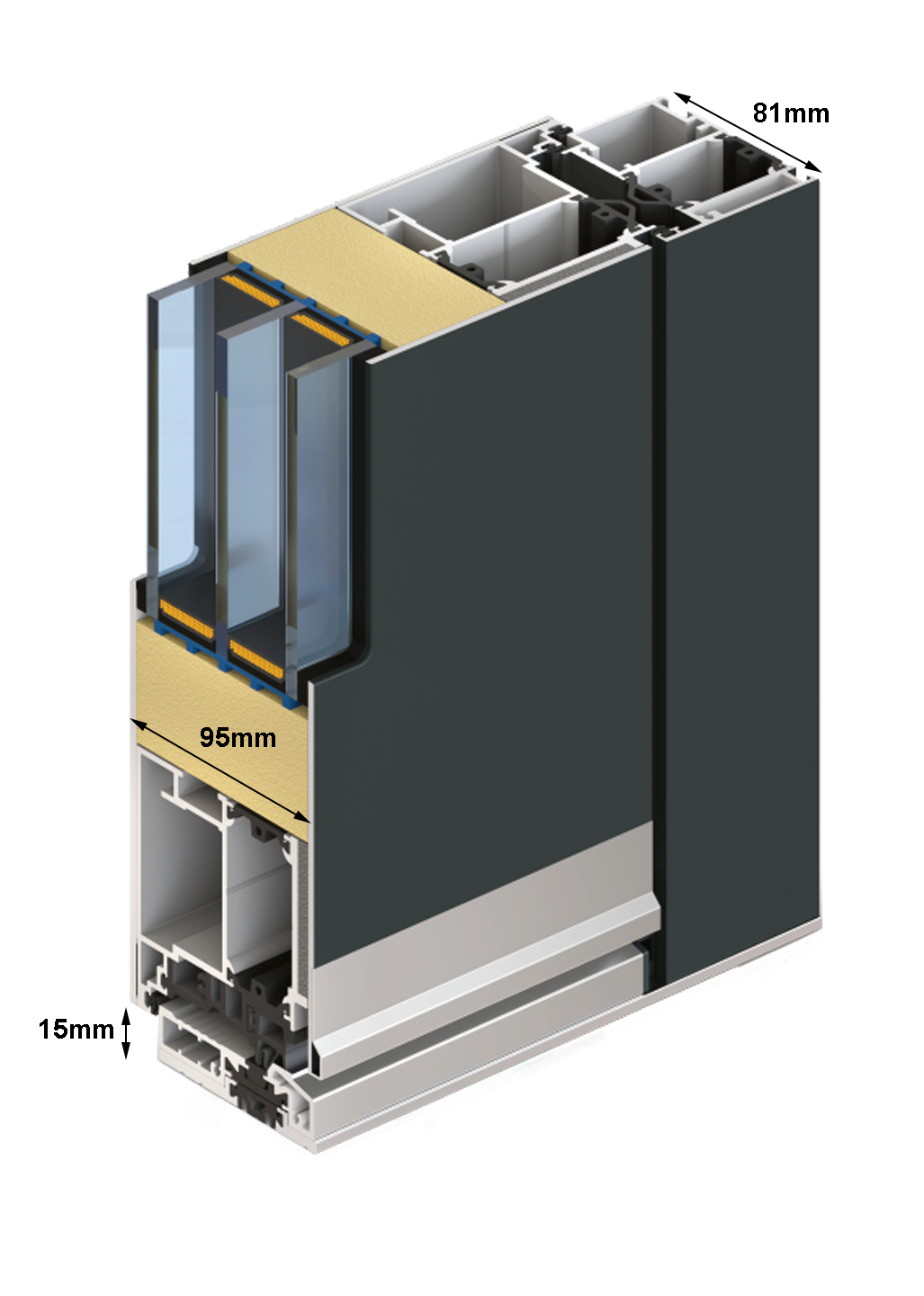
Thresholds and Weatherseals
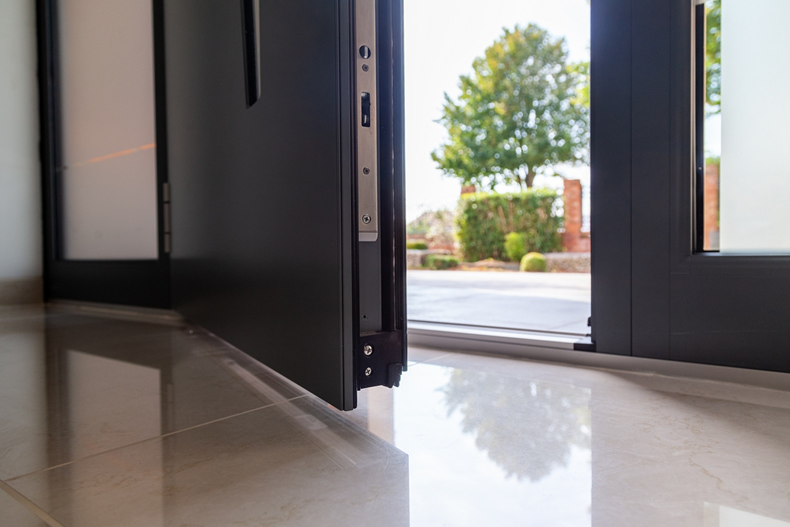
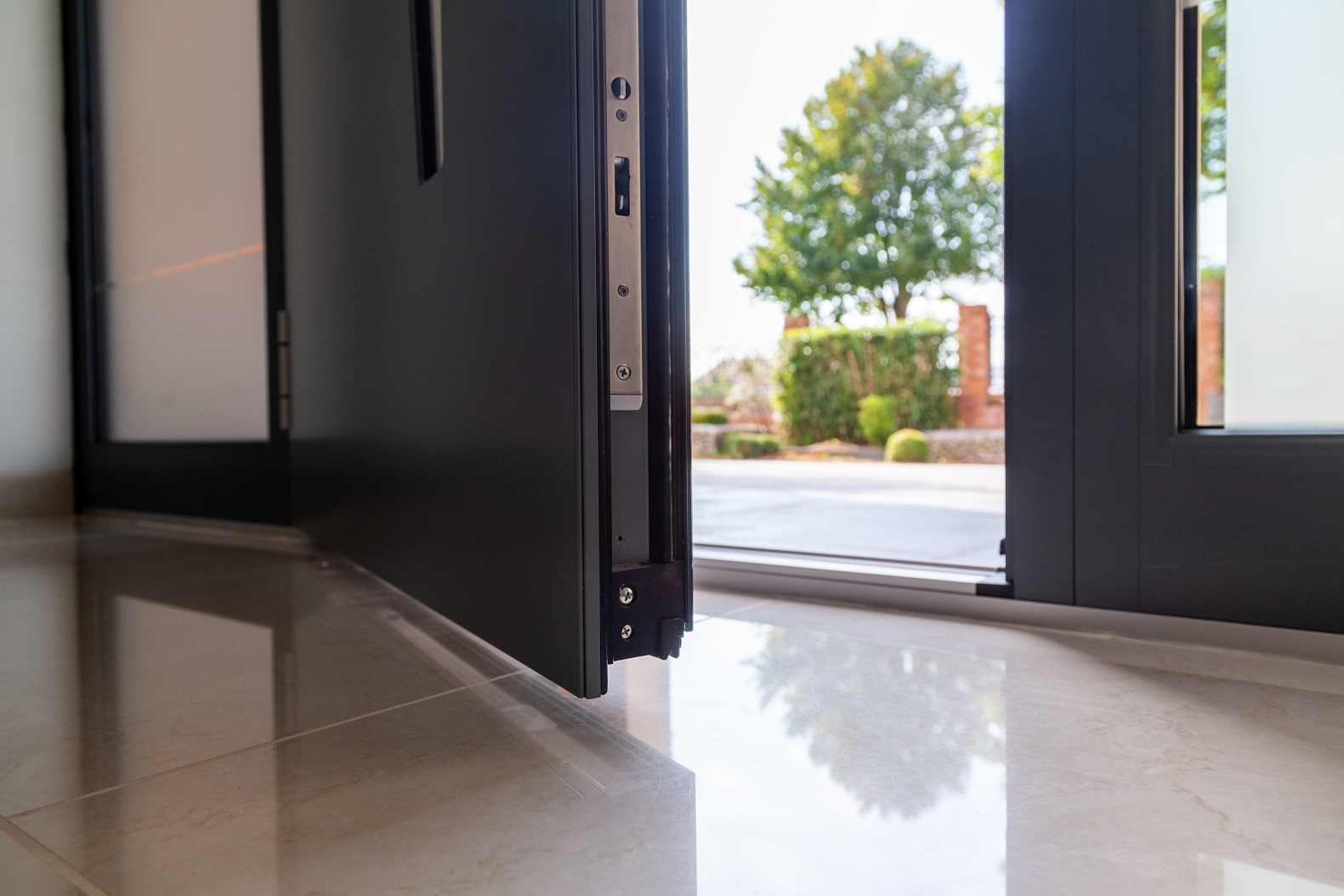
Spitfire Doors feature very quality high-quality thresholds and weatherseals, designed where high performance and Passive House is desired.
Front Door Installation
The key area that is often overlooked is installation. Even the best designed and manufactured door will perform poorly if fitted badly. Spitfire recommends that all doors are fitted by authorised Spitfire Doors Partners across the UK and Ireland. Installation is critical because a badly installed door will not perform well if it is badly fitted and that is why we always recommend you use Spitfire Doors or Spitfire Doors approved installation partners. This is even more critical in Passive House situations.
Building Regulations
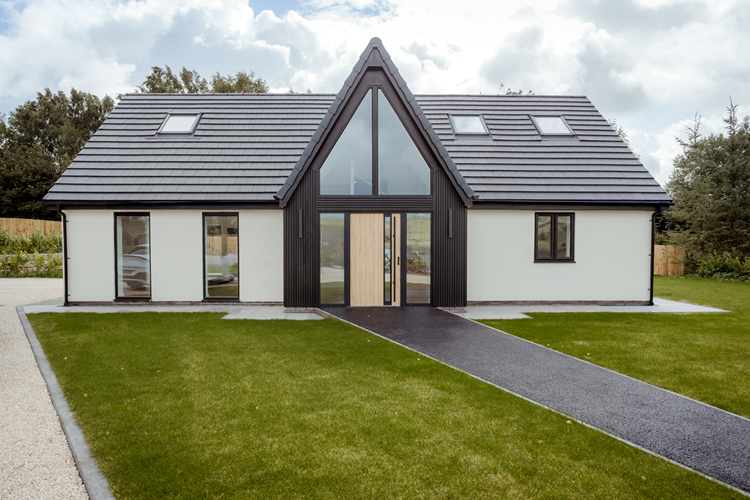
In the UK, Building Regulations stipulate that external doors must meet several standards. The maximum (or worst) U Value for an external door in a new build or a significant renovation is 1.4 W/m²K, in Scotland it is 1.2. That is the minimum requirement and if you want to significantly increase the performance of your door aim for 0.9 W/m²K or lower. Get in touch with Spitfire Doors
Assurance
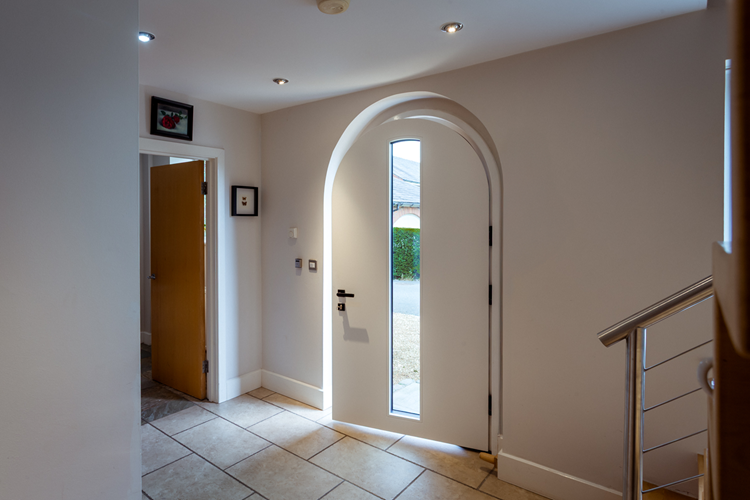
By choosing a front door with a low U Value, you will reduce your energy bills, improve the comfort of your home and contribute to a more sustainable future.
Rest assured that all Spitfire Doors conform to and easily beat Building Regulation requirements and we have doors that achieve as low as 0.6 W/m²K, if required.
Please contact us if we can help or advise you in any way.
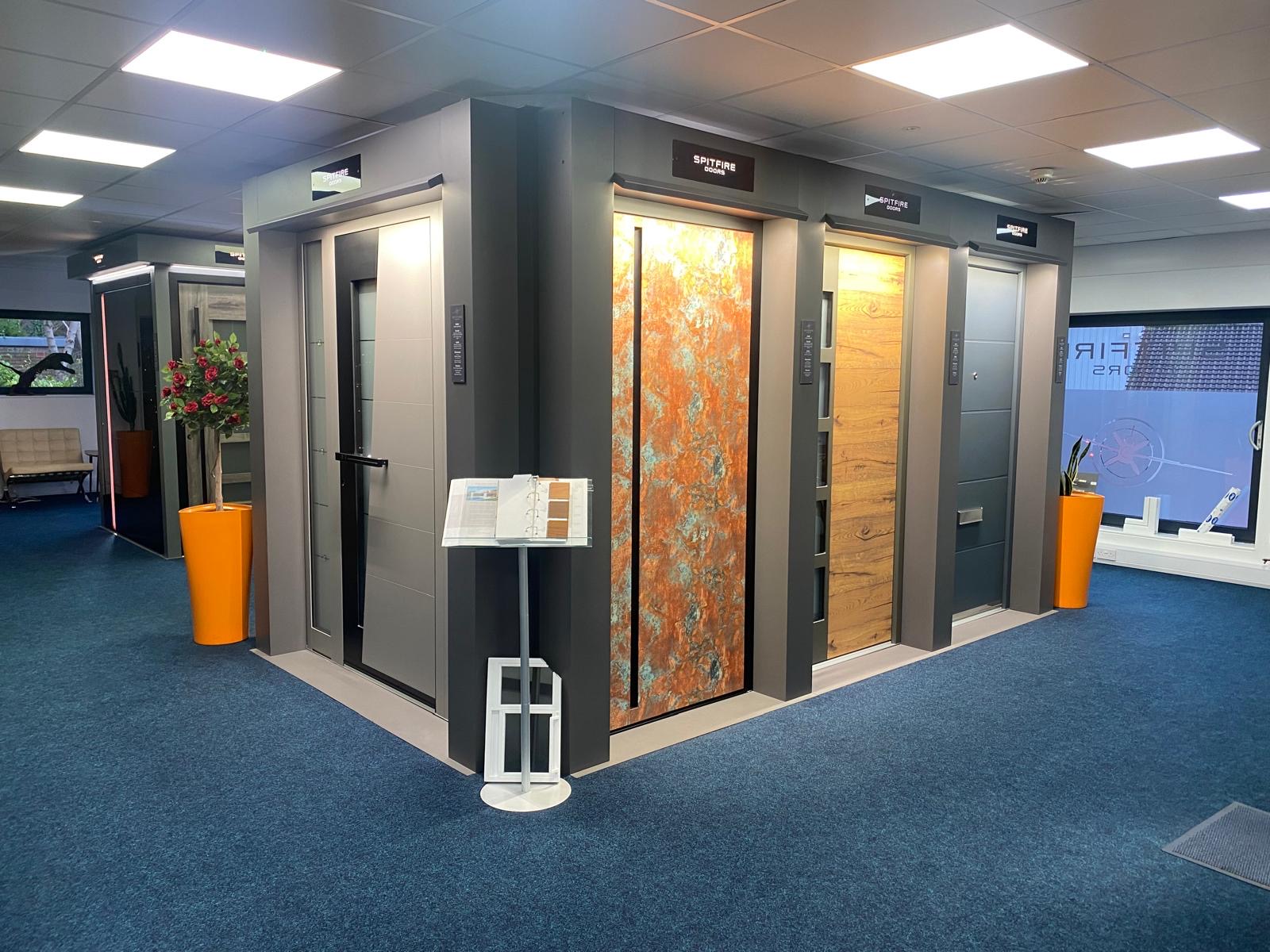
You are very welcome to visit our Flagship Showroom in Macclesfield, Cheshire. To give you the best possible experience and to ensure we can show you the full range of doors, please make an appointment prior to your visit – call 01625 412570 or email enquiries@spitfiredoors.co.uk. We look forward to hearing from you.

What is a net zero home?
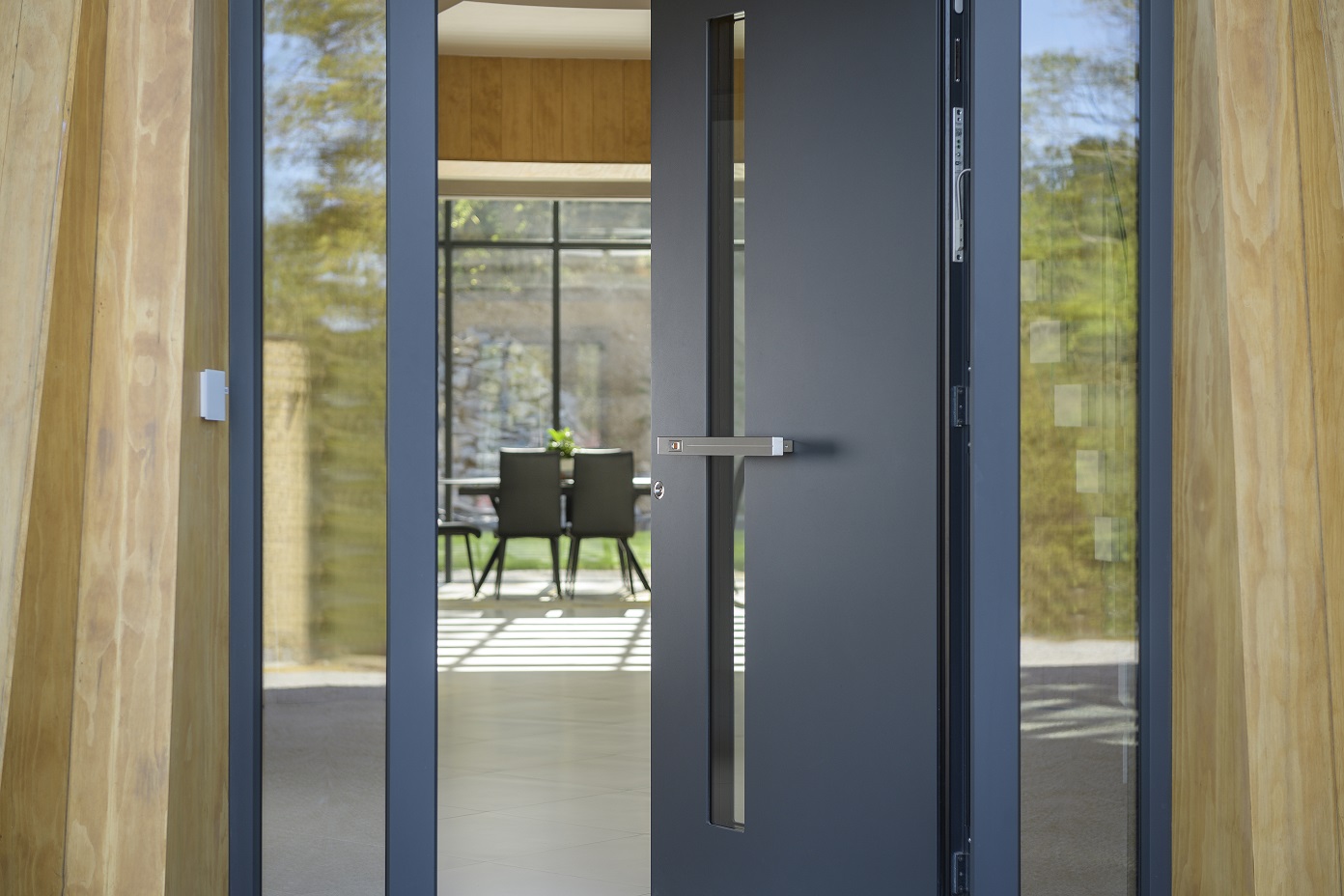
A net zero home combines advanced design and superior building systems with energy efficiency to produce a home which is well insulated with a high level of air tightness.
A net zero home can look like any other home. What makes them different is that the building components are more energy efficient and more durable than the average property. The walls are thicker and the doors and windows are made to a higher specification than standard doors and windows, with enhanced features such as thicker door sashes, triple glazing, excellent weather seals and a higher grade of insulation.
A net zero home is comfortable, healthy, sustainable and carbon-free and the total cost of living in a net zero home is lower than that of a comparable standard home.
Rocia Concha, Director of Policy and Advocacy at Which?, said in 2021: “Decarbonising millions of households across the UK is a vital but complex component of the government’s net zero strategy. The level of support consumers need must not be underestimated.” Spitfire Doors has always been ahead of the game with the specification of the S-500 Signature Series doors meeting Passive House standards. Contact Spitfire Doors
Energy efficient front door
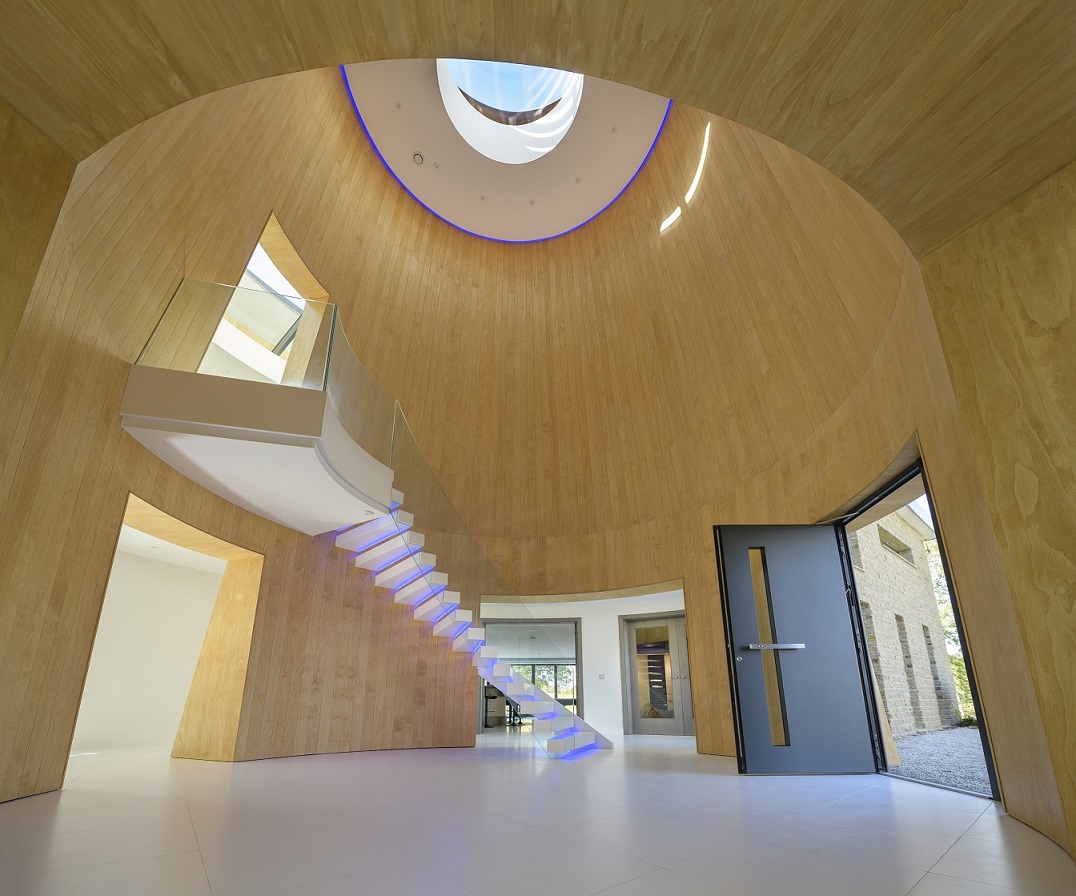
An energy efficient front door will have excellent weathering properties to ensure there aren’t any gaps around the door which would allow cold air in and will help to reduce heat loss within the home.
Selecting the correct doors and windows is essential when taking steps to achieve a low-energy building.
What is a good U Value?
U Values measure how effective a material is as an insulator. The lower the U Value the better, meaning that less energy is required to maintain comfortable conditions inside the building.
In 2018, Part L building regulations specified that a replacement front door should have a U-Value no higher than 1.8 W/m²K.
Spitfire Doors S-500 Signature Series Doors have a good U value of just 0.6 W/m²K. Every door, regardless of the style, is combined with excellent weather seals and thick thermally enhanced door slabs. Every front door with glazing features triple-glazed, laminated safety glass for extra security and thermal enhancement.
There are over 400 customisable Spitfire Door designs and fully bespoke options to complement a wide range of properties, with each style being capable of achieving Passive house standards.
Find out more about Passive House standard (German: Passivhaus)
Is Aluminium Sustainable?
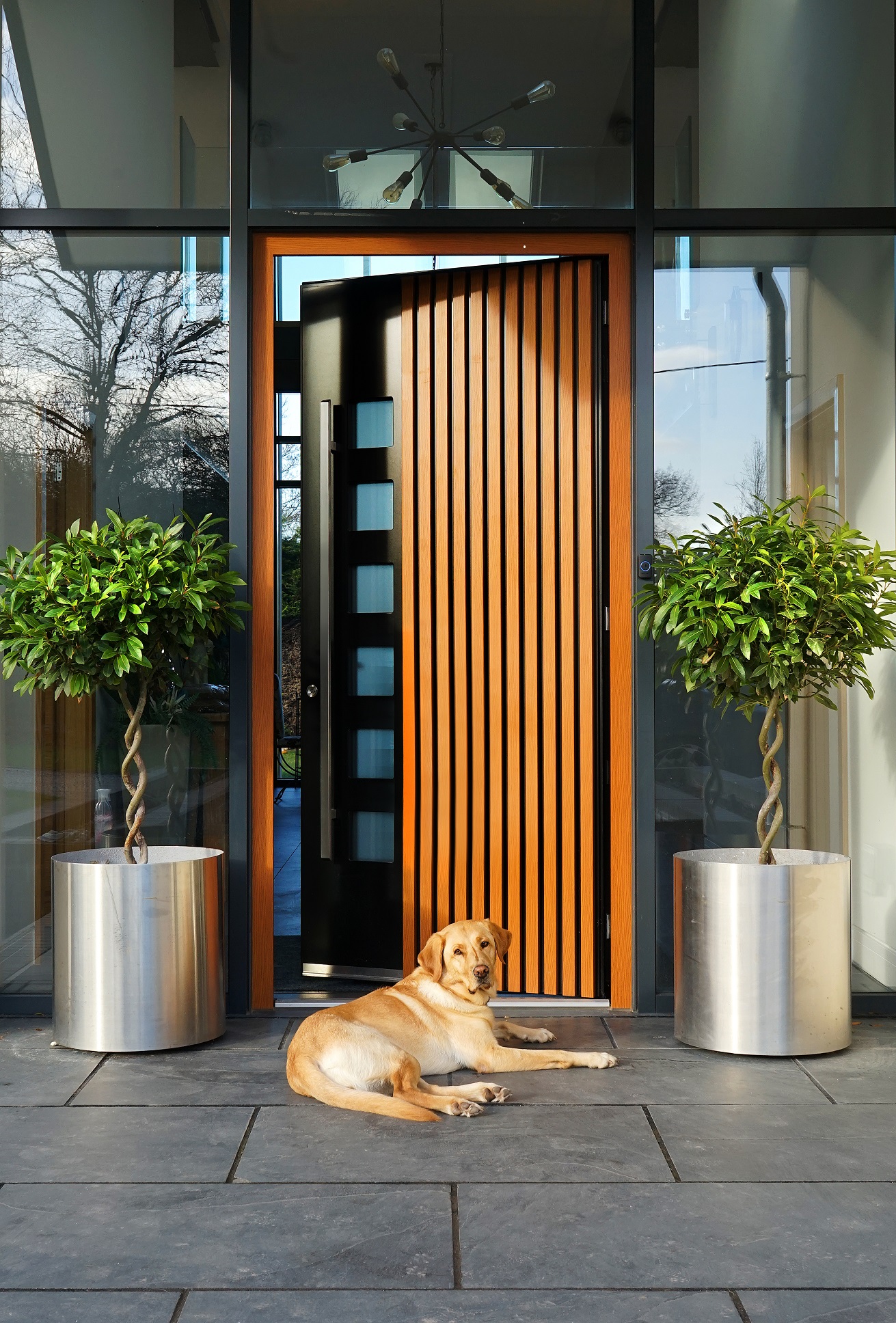
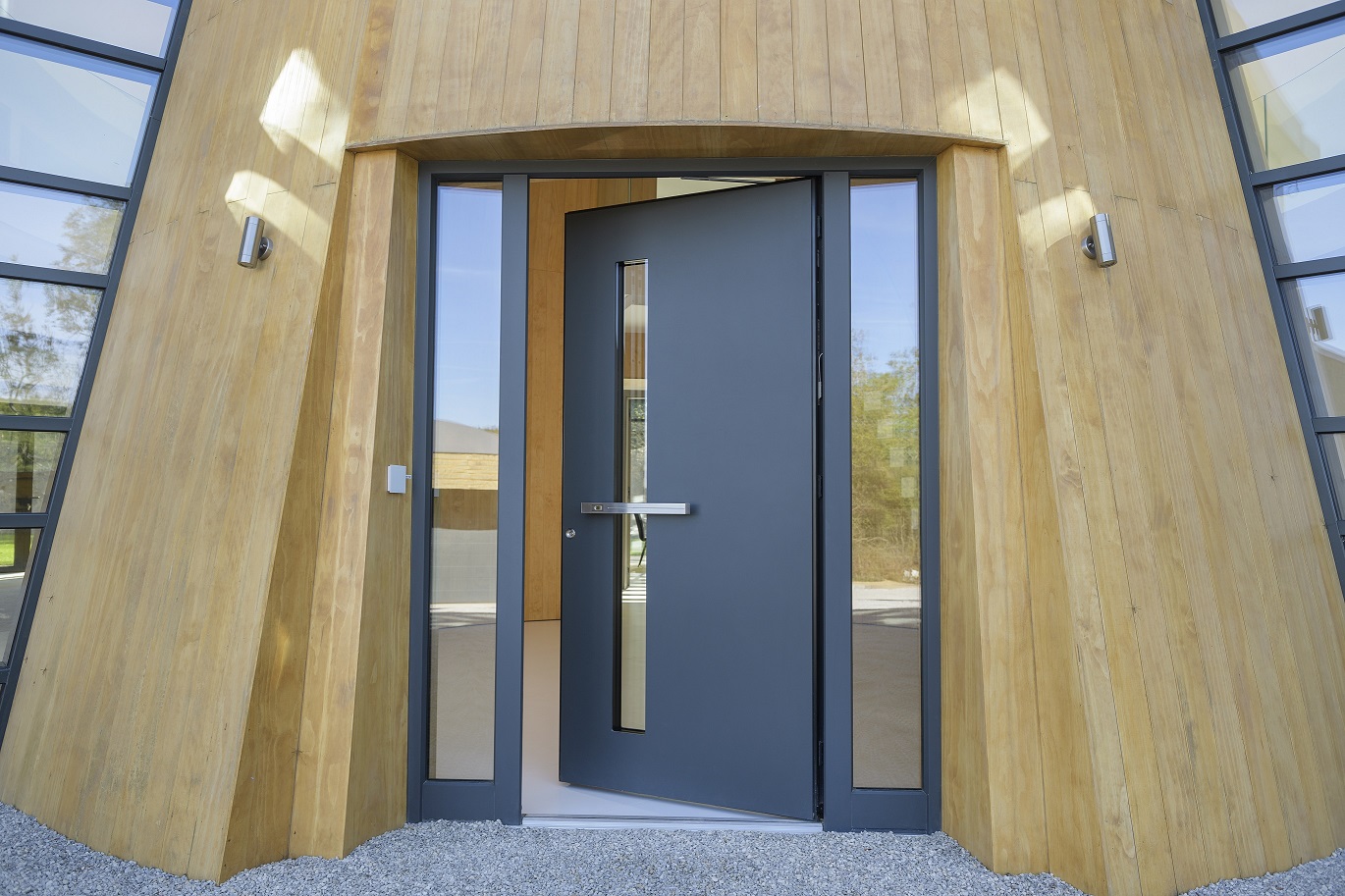
Whilst an Aluminium front door will look good and perform well for many, many years, it is reassuring to know that Aluminium is one of the most environmentally friendly materials on the planet. The process of melting aluminium down to its molten form does not change any properties of the metal. At the end of its life, a Spitfire Aluminium front door can be recycled infinitely, creating minimal long-term impact on the environment.
Carbon Footprint reduction
We all have a carbon footprint. At Spitfire Doors we are taking steps to actively reduce ours. As a company, we proactively reduce, reuse and recycle where we can. We take care when delivering our Aluminium front doors and encase our S-500 Signature Series Doors in a timber frame, rather than using wasteful packaging. In our offices and showroom, our lights operate on a sensor, so when the rooms are not in use, the energy usage is kept to a minimum.
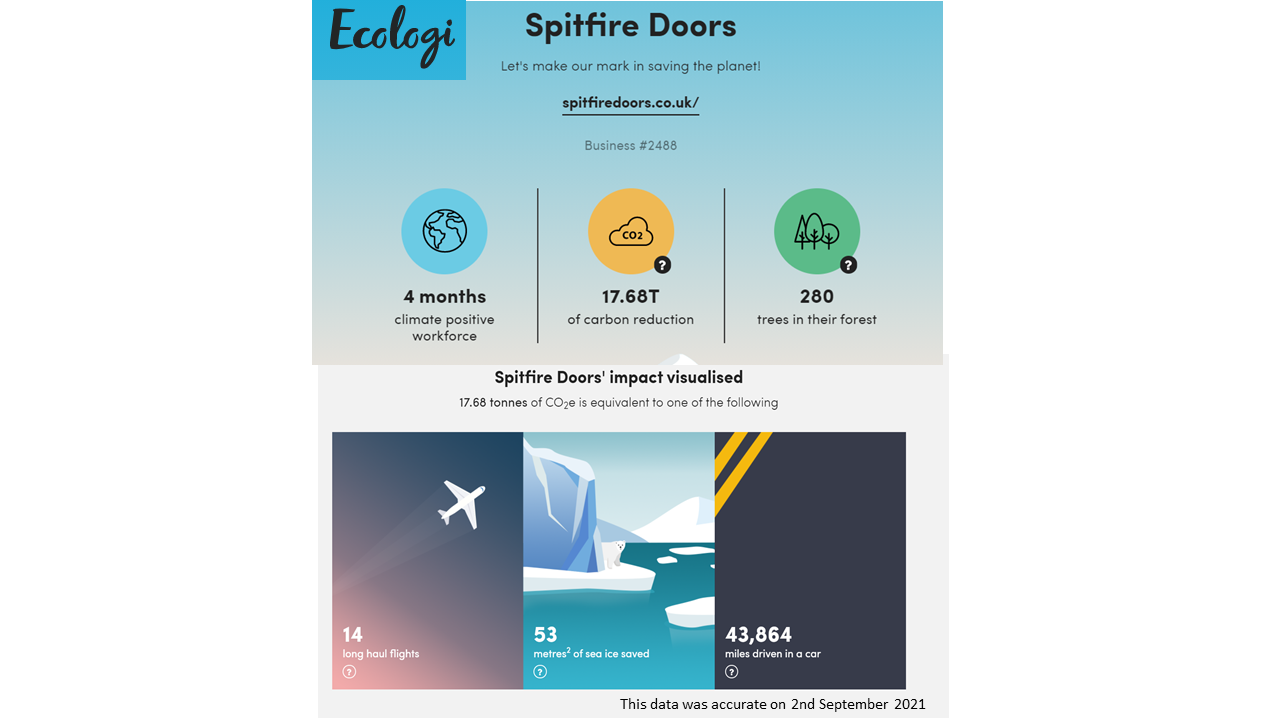
In 2021, Spitfire Doors made the decision to invest in a Carbon Offset programme with Ecologi.
Ecologi invest money into projects that remove more greenhouse gasses than a company’s carbon footprint puts in. Every month we support a range of carbon reduction projects that are certified at the very highest levels by Gold Standard and equivalent. Within the first four months of supporting Ecologi in their work, Spitfire Doors reduced 17.68T of carbon emissions and facilitated the planting of 280 trees.
If you would like to find out more about Spitfire Doors wide range of Aluminium front doors, please visit our door designer and take time to create the perfect door design for your home. Our Gallery of images includes a wide variety of styles available.
You are very welcome to visit our Showroom in Macclesfield, Cheshire, where we have over 14 Aluminium Entrance Doors on display. Please get in touch with our Customer Services team by calling 01625 412570 or contact us by email and we will be happy to help you.